


Exercise Ocean Safari 83
Historical Articles mentioned in the book
“Whosoever commands the sea commands the trade; whosoever commands the trade of the world commands the riches of the world, and consequently the world itself.” Sir Walter Raleigh.
Exercise Ocean Safari 83 took place between 3-17 June mostly in The North Atlantic, and was a bit on the big side. It involved 90 ships and was the largest naval movement since The Falklands conflict, even bigger than Fleet Ex 83 which involved three carrier battle groups, but only just over 40 ships in total.
It was a large multi-national NATO force, with Blue Forces led, by the aircraft carrier The USS John F. Kennedy (CV-67). Other carriers involved were the USS Nimitz (CVN-68), HMS Hermes, HMS Illustrious, HMS Ark Royal the French carrier FS Foch (R99), and even the USS America (CV-66). The USS America, steaming home from The Middle East, had to pretend to be a Kiev class ship acting as lead of Orange Force, and was immediately surprise attacked by The USS John F Kennedy’s air wing while still a thousand miles away from the Ocean Safari group.
The purpose of the exercise, while just another part of President Reagan’s PSYOPS, was intended to ‘poke the bear’ and show that NATO could fight a ‘Reforger’ convoy across the Atlantic in a high-threat scenario, while simultaneously engaging in force projection and ASW (Anti-Submarine warfare), signalling to The Soviet Union that their naval forces (Red Force) were highly vulnerable and that they could not compete indefinitely with NATO’s naval power.
While highly focused on ASW, simulated air-strikes were made on military installations in France, West Germany, and England, to represent strikes on Soviet bases and forward moving Soviet armoured deployments in Western Europe. The attacking ‘Orange Forces’ were played by The Foch, and other British, US and NATO members, with the British Buccaneer aircraft proving particularly effective in their low-level anti-ship strike role, albeit now somewhat restricted in their range due to the fact that they were by then, all land-based.


Above: The projection of power can range out over a thousand miles from the CBG. An F-14 Tomcat from VF-31 fighter wing. Below: A-6 and other aircraft viewed from the bridge. All author's photos unless otherwise credited.
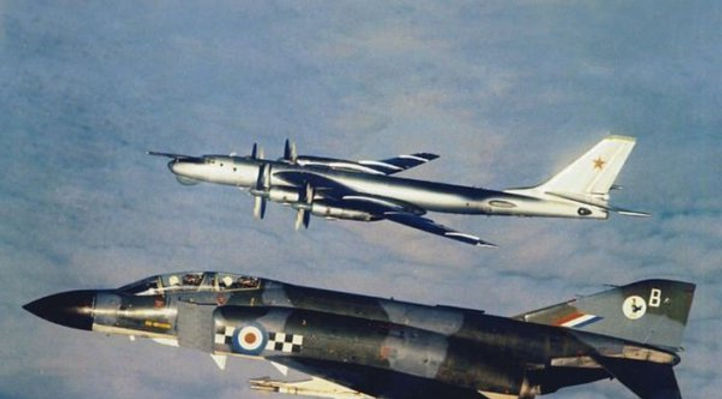
Soviet TU-95 'Bears' from Red Force were regular visitors, taking a look at what was going on,but were usually intercepted at great distance from the convoy. Photos: MoD Navy.

Sub-Lt Watson's FRS-1 Sea Harrier being unloaded from the Spanish cargo ship Alraigo in Tenerife. I had written a lot by that time on the use of merchant ships for military purposes, but this one was not in the plans at the time.

The Harriers from Ark Royal and Illustrious made a good showing, but on June 6th, a FRS-1 Sea Harrier from Illustrious flown by Sub-Lieutenant Ian Watson (his first NATO exercise), had a sector radar and radio failure (everyone was on radio silence anyway) and could not find his way back to his ship, and suffering low-fuel, made an emergency landing on the Spanish cargo ship Alraigo, a story I also covered. He was tasked with finding the Orange Force French carrier Foch far off the coast of Portugal, but after his equipment failure, headed towards a shipping lane, intending to eject near a merchant ship, but noticed the containerised cargo could give him a flat spot to land. Landing safely, well, kinda, the ship sailed for Santa Cruz, Tenerife, arriving four days later on 10th June. The plane was totally salvageable, and the ship’s owners and crew were awarded over half a million in salvage. The Harrier (and the pilot) went on to fly again for many years, until the aircraft was retired from service in 2003, and went thereafter to a museum in Nottinghamshire.

While aboard the Kennedy, I was given the opportunity to speak with the Captain Gary F. Wheatley and the Admiral commanding the carrier battle group (CBG), who advised us not to photograph the radars, which we immediately did, but could see nothing new or particularly interesting, which was dissapointing, as I was particularly interested in ‘over the horizon’ (OTH) radar at that time, having had my interest sparked by recording the Soviet ‘Woodpecker’ OTH when I was on the trawlers some time earlier. But I wasn’t alone in taking pictures, I did not publish mine at the time, as the whole exercise was plagued by Red Force CCCP Trawler/AGIs who no doubt got their own pics with their Praktikas. Apparently, we had between 50 and 75 of them identified and logged during the exercise. One of the Soviet trawlers caught fire of it’s own devices, and was ably assisted by a Royal Navy Leander class frigate which went to aid the trawler, which we all found to be highly amusing.
I have always wondered why we call them trawlers and not just AGIs (Auxiliary General Intelligence) or Spy Ships, as most I ever saw had absolutely no way of actually fishing, unlike our own Trawler/AGI fleet on which we actually had to catch fish as well, to pay our wages, which was not an easy task, having to get out of bed every three hours or so to haul our nets. But this was allegedly ‘character forming’ as a youngster in the 1970s. Most of out (NATO’s) antenna were housed, but the Soviets were totally shameless most of the time and did not cover them up. Rather them than me having to de-ice all those antennas up in the northern latitudes with an axe, and a steam hose if you were lucky.
It seems that only the USS Enterprise and the Bainbridge had OTH radar in those days and it wasn’t all that successful, being sent backwards by the satellites that were coming on stream, like the Keyhole 11 which had some really impressive abilities. However, I digress, as I am prone to do on occasion, as you will no-doubt know already if you have read the book.
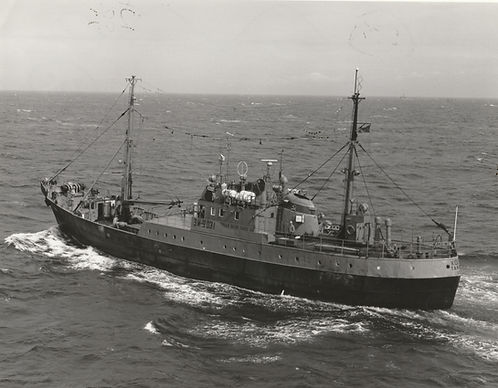
Two Soviet AGI's, with one on fire, you can just see the bows of the Leander class frigate that went to her assistance, so she could go 'fishing' again... Note the complete absence of any fishing gear. Pics: FotoFlite.


“It will be U. S. policy that a nuclear war beginning with Soviet nuclear attacks at sea will not necessarily remain limited to sea.” US Secretary of Defense Caspar Weinberger.


The biggest aspect of Ocean Safari was countering the submarine threat. Top: With just the scopes and antenna showing, a submarine is difficult thing to see in a turbulent sea, but The P3s, Nimrods and carrier-borne S-3A Vikings could spot them from great distance. Pic: MoD Navy. Anyone know what the sub is? Above: Submarines and Targets Photo: Kongelige Danske Marine. Right: Soviet Juliet class on the surface. Pic: FotoFlite.
You might think that Casper Weinberger's statement was rather bloody obvious, but nuclear powers were never all that open about nuclear weapons, and would “neither confirm nor deny” if they were being carried on a specific ship, with very good reason. I never asked that question, as the answer leaned into 'The University of the Blinding Frigging Obvious' category. But, nuclear weapons was a hot topic of discussion in many areas at that time.
In the event of a hot war, The Atlantic Ocean would have most likely been the first battlefield, as the trigger for a confrontation always existed, and the likelihood of a nuclear exchange at sea, could never be guaranteed not to spread to full nuclear exchanges on land. Even the targeting of a strategic asset with a conventional weapon, in the shape of an SSBN, or even an SSN carrying any nuclear ordnance, could be the trigger to a much bigger conflict. One had to be a bit careful, and the policy of The West was that we would, never, or at least be very unlikely, to initiate such a strategic action. But it could happen.


Above: one of those things that you really, really don't ever want to see. An SSBN does an underwater launch of an intercontinental ballistic missile, which will really and truly mess up someone's day. Pic: Shutterstock.

The objective of Cold War ASW was to locate enemy submarines and never let them out of our sight (or hearing). We were good at it, and relied on the fact that our submarines were, mostly, better and a lot quieter than the oppositions. It was an oft-heard joke that a US or NATO submarine would sail into Polyarny undetected - in order to complain about the noise. The Akula and later Yasen classes of Soviet submarine however, and some of their diesel electric boats, were extremely quiet, and we could not always guarantee we could find them.
So, if The Cold War went hot, would you then take out all their ballistic missile submarines you had within hearing? Or would this lead automatically to full nuclear exchange? In an ideal world, you would not want this to happen. If you saw one launch then yeah, he was a goner. But would you take out all the rest you had on the plot if only one launch? Back to the old Boston and Kiev discussion, that suggested we would accept one strategic hit without full-scale retaliation.
At the time, maybe not common knowledge outside of politics and the military was that, we, The West, would indeed be the first to use nuclear weapons, but not the first to start the conflict. This was because of the then massive numerical advantage of the Soviet ground forces. It was thought that the conflict would start with a massive ground attack into West Germany, and that within a 5 to 7 days we would be forced to use small theatre nuclear weapons to halt or stall their advance, to give reforge (Reinforcement of Germany) time to take place via the likes of Ocean Safari type convoy(s), which the soviet submarine and air assets would attack. And, once you have used theatre nuclear weapons, it would not be long after that, maybe as little as another week or less, before theatre became tactical and tactical became strategic.
Which, would give us two weeks to get Reforger done and into battle – which we simply could not do. Thus, the convoy(s) would have to start sooner, and the likelihood was, that the Atlantic would be the first, or at least simultaneous battlefield to Germany. Thus, Ocean Safari was absolutely critical in proving the deterrence that we could fight a convoy through in a hot-war situation. In the same way as was Bright Star 83 in proving that the US could rapidly deploy a very large force in a short space of time.
How would the attack come? Would be it from a group of Backfire B aircraft flying in close formation to appear on radar as only one blip, where a nuclear missile could take out the whole group of attacking aircraft? Or other aircraft from Cuba or Granada? Thankfully 'Cuba II the sequel' never happened as was taken out as a Soviet forward operating base later in the year by Admiral Joe 90 and The USS Independence CBG. But, what if they were conventionally-armed? You don’t want to escalate already…
Or, if the group knew you might fire a nuclear weapon at them, would they split up as single targets, more spread out so that one missile could not take them all out in one hit? And were they intending to fire a nuclear missile at the CBG/convoy or make a conventional attack so as not to escalate?

Top left: A Royal Navy Sea-King ASW aircraft drops in dunking sonar into the oggin. Pic: MoD Navy. Above: The very capable and hard-worked MR-3 Nimrod Maritime reconnaissance aircraft. Pic: BAE Systems. Bottom: USS Aylwin FF-1081 is a Knox class ASW frigate which worked with The Kennedy battle group.


Or would the attack come from beneath the waves from a hunter-killer submarine that you had not yet perfectly located, justifying the use of a nuclear sub-surface nuclear weapon to make sure it could not sink you first?
The decision on whether to use nuclear weapons was almost always The President’s call. I say almost, as what if all your satellites and communications had already been taken out? Unlikely if still in a conventional scenario, but not impossible.
This is all about people. The whole world is about people. Individuals who make decisions based on the information and intelligence available to them at the time. Which may not be complete, and rarely is.
Airborne ASW was a big part of Ocean Safari, and a substantial wing of P-3 aircraft were ordered to go to Montijo Air Base in Portugal, where they operated far over the Atlantic in their ASW role. They deployed and were operational within 72 hours operating three squadrons of P-3s (VP-64, VP-66 and VP-91) around the clock in support of the CBG performing 32 long-range sorties.
Pic: DoD Navy.

There is me sitting there trying to make a decision on whether to have the pasta or fish for lunch, while many others have the burden of life or death decisions for whole populations on their minds. Jeez, I am glad I only had to report on it.
However, Ocean Safari proved that it could defend the North Atlantic and the sea lanes, and reenforce Europe, adding more deterrence to the likelihood of attack, no doubt noticed by Soviet Admiral Sergey Gorshkov CinC of The Soviet Navy, but also noticed by President Yuri Andropov, and no doubt adding another tick to his Operation RYaN box.
PS. I went for the fish.


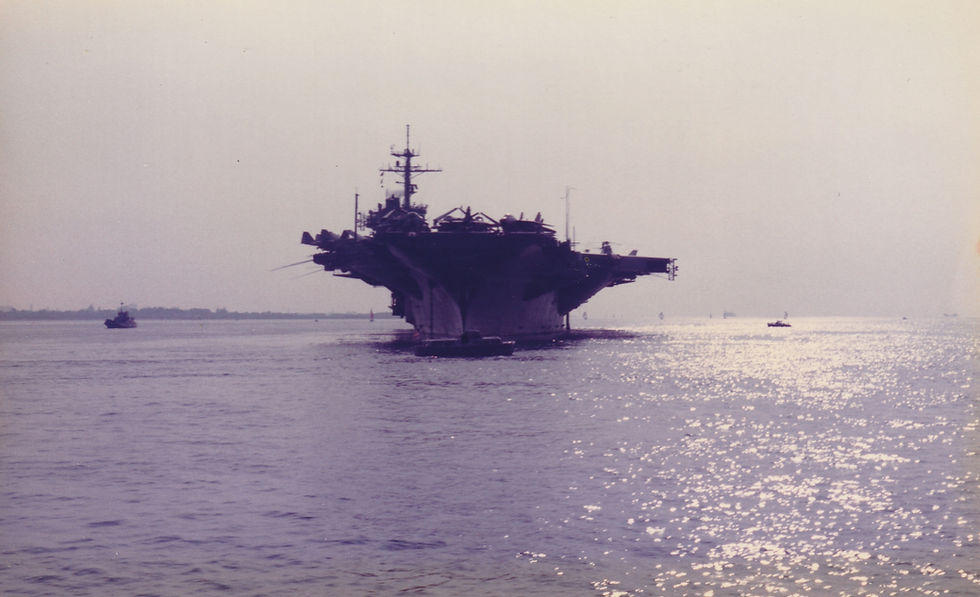
As the sun sets on Exercise Ocean Safari 1983, The USS John F. Kennedy comes to anchor in The Solent on Britain's south coast, where they were entertained at Portsmouth between 18-22nd of June for a few days Rest and Relaxation (R&R). Later in the year, while en-route to their Indian Ocean deployment, on 23 October 1983 a suicide attack at Beirut Airport, took the lives of 241 US Marines and 58 French paratroopers. A month later, while off The Lebanese coast, Kennedy was to lose two of it's F-14A aircraft with the tragic loss of life of two Aircrew, Lieutenant (jg) Cole P. O’Neil and Commander John C. Scull (RIO).